Spices Distributorship Opportunities in India: A Practical Guide for Distributors and Manufacturers
Spices Distributorship Opportunities in India: A Practical Guide for Distributors and Manufacturers
Walk into any Indian kitchen and you’ll find a spice box within arm’s reach. Turmeric, red chili, coriander, cumin, and garam masala aren’t occasional purchases. They’re part of daily cooking. That steady, repeat demand is why spices sit firmly inside the FMCG market and why spice distributorship attracts both first-time entrepreneurs and established distributors.
But a good product doesn’t reach the shelf on its own. Manufacturers need reliable partners who can stock, deliver, and build relationships with retailers. Distributors need brands worth representing. Very often, the real problem is simply finding each other.
This guide explains how spice distributorship works, what to check before you commit, and how manufacturers can build a distribution network. It also covers how B2B platforms such as GrowDistributors help manufacturers and distributors discover relevant opportunities. If you want a focused overview of the core topic, you can also visit our [Internal Link: Spices Distributorship Page].
Understanding Spices Distributorship in India
So what does spice distributorship actually mean?
A spice distributor buys products from a spice manufacturer or brand. The distributor stores them and supplies them to wholesalers, retailers, and sometimes institutional buyers such as restaurants and caterers within an agreed territory. The distributor is the link between a producer’s facility and the shop where a customer picks up the packet.
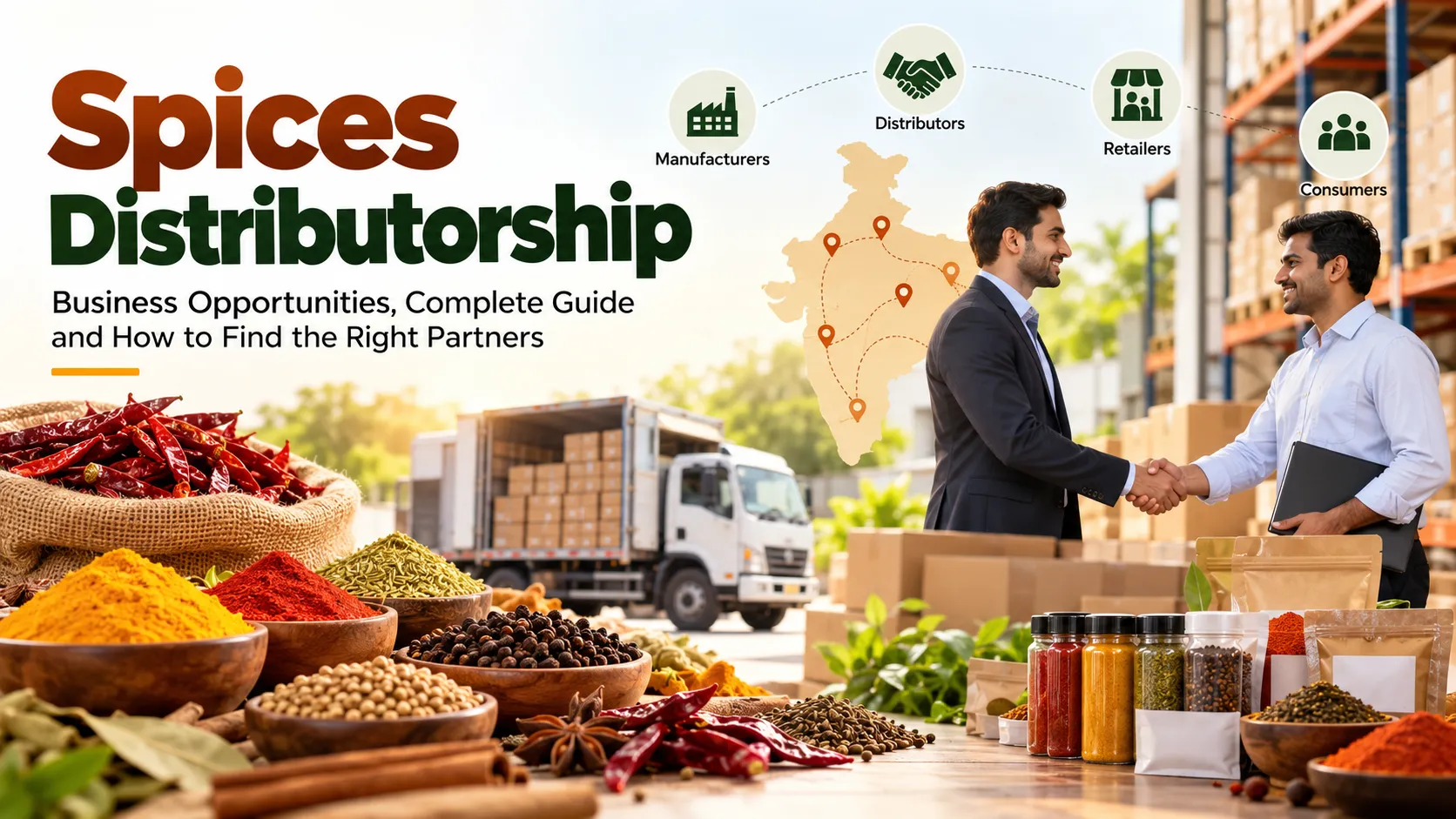
How the spice distribution ecosystem works
The flow usually looks like this:
- Manufacturers and brands produce, pack and market the spices.
- Distributors buy in volume, manage stock and serve a territory.
- Wholesalers supply smaller shops and often buy in bulk.
- Retailers, such as kirana stores, supermarkets and specialty shops, sell to consumers.
- Consumers and commercial buyers purchase for homes, restaurants and catering.
The exact structure varies by brand and region. Some manufacturers work through several layers. Others prefer direct distributor relationships.
Why distributors matter to product availability
A brand can have excellent masala and still fail if the product isn’t on shelves when customers look for it. Distributors handle the unglamorous work that creates availability: regular supply, timely delivery, retailer visits, stock rotation and payment follow-up. This is how a brand moves from a local name to a regional presence.
Why Spices Distributorship Is an Attractive Business Opportunity
Let’s be clear about what this opportunity is and isn’t. Spices are a repeat-purchase category, so demand is more predictable than in many other consumer segments. That doesn’t make profit automatic. Results depend on the brand, your terms, your territory and how well you run operations.
Here’s why many people look at this business:
- Regular consumer demand. Households buy spices again and again, which supports repeat orders from retailers.
- Household and commercial consumption. Homes, restaurants, caterers and food businesses all need spices, which widens your customer base.
- Different product categories. You can work with whole spices, ground spices, blends and specialty products.
- Retail and wholesale channels. You can supply neighbourhood stores, larger retail outlets and wholesale buyers.
- Fit for existing FMCG distributors. If you already run delivery routes and serve retailers, spices can be a natural addition to your portfolio.
- Entry point for new entrepreneurs. Many food and household brands need partners, so a newcomer can choose a brand and territory that matches their local knowledge.
Competition is real too. Many brands, from national names to regional players, already compete for retailer attention. Your advantage will come from the quality of your brand selection, your service and your local relationships.
Different Types of Spices Distributorship Opportunities
Not every spices distributorship looks the same. Knowing the differences helps you choose a model that suits your resources.
Branded masala distributorship
You represent a known masala brand. Retailers already recognise it, so selling can be easier. The trade-off is that established brands often have strict terms and sometimes limited territory availability.
Packaged spices distributorship
This covers sealed, labelled and ready-to-sell packs. Packaging helps with shelf life and presentation, but you’ll need to manage stock carefully because packaged goods have printed expiry timelines.
Whole spices distribution
Whole spices such as cumin seeds, cardamom, cloves and pepper need proper handling. Quality depends heavily on sourcing, cleanliness and storage. Buyers often include restaurants and wholesalers.
Ground spices distribution
Powdered spices are sensitive to moisture and aroma loss. Packaging quality and storage conditions matter a great deal here.
Blended masala distribution
Blends such as garam masala, sabzi masala and regional mixes depend on formulation consistency. If a blend tastes different from batch to batch, retailers hear about it quickly. Ask the manufacturer how they maintain consistency.
Regional spice brands
Local brands often understand regional taste preferences well. They can be a strong fit in their home markets, though brand recognition outside those areas may take more effort.
Premium and specialty spices
Organic, single-origin or gourmet products target a narrower customer group. Margins and pricing may differ from mass-market products, but the customer base is smaller and needs more explanation at the retail level.
Wholesale spice distribution
Here you supply larger quantities to traders, caterers and commercial buyers. It usually involves less branding work and more focus on pricing, credit terms and reliable supply.
How to Start a Spices Distribution Business
If you’re asking how to become a spice distributor, start with homework, not a purchase order. Here is a practical path.
Understand your local market.
Which brands already sell well in your area? Which retailers are underserved? What do local customers prefer: strong, mild, or traditional regional blends? A gap in your territory is often your best opening.
Select suitable spice brands.
Look for brands that match your market, not just brands that sound impressive. A smaller brand with good product-market fit can serve you better than a famous one that is already crowded in your area.
Evaluate product quality
Ask for samples. Check aroma, color, texture, packaging strength, and labelling. Cook with the product if you can. If retailers or consumers dislike it, your distribution effort will suffer.
Understand distribution terms
Before you agree to anything, get clarity on:
- Territory and exclusivity
- Pricing structure and margins
- Payment and credit terms
- Return and replacement policy
- Minimum order expectations
- Duration and renewal of the arrangement
Get everything in writing.
Assess storage and logistics
Spices need clean, dry, well-ventilated storage away from strong odours. Think about space, shelving, pest control, vehicles and delivery routes. Poor storage can damage stock before it ever reaches a customer.
Evaluate manufacturer support
Does the manufacturer provide marketing material, retailer schemes, product training or sales support? A manufacturer that actively supports its distributors makes your job much easier.
Build retailer and wholesale relationships
Spices sell through trust. Regular visits, dependable delivery and fair dealing matter more than one-time discounts. Start with a few strong relationships and expand carefully.
Understand registrations and food-related compliance
Food businesses in India generally need to meet food safety requirements, and business registration and tax requirements may also apply. The exact licences depend on your activity, scale and state. Check current rules with the Food Safety and Standards Authority of India, your local authorities or a qualified professional rather than relying on a general article.
Plan distribution operations
Decide how you’ll manage orders, billing, stock records, delivery schedules, and collections. A simple, organised system prevents the most common beginner problems: stock mismatches and delayed payments.
How to Choose the Right Spices Distributorship
Many people ask what to consider before taking a spices distributorship. This checklist covers the essentials:
- Brand reputation. Is the brand trusted by retailers and consumers in your region, or is it still building awareness?
- Product quality and consistency. Is the taste, colour and aroma the same from batch to batch?
- Pricing and margins. Are the margins workable once you account for transport, storage, schemes and credit?
- Territory availability. Is your area clearly defined, and will the manufacturer appoint competing distributors in it?
- Distribution rights. Are your rights exclusive or non-exclusive, and what are the conditions to keep them?
- Supply chain reliability. Can the manufacturer deliver on time, consistently?
- Marketing support. Will the brand help create demand, or will you be expected to do it alone?
- Packaging and shelf life. Is the packaging sturdy, and is the shelf life realistic for your turnover speed?
- Return and replacement policy. What happens if stock is damaged, expired or doesn’t sell?
If a manufacturer is vague on any of these points, treat that as a signal. Good partners answer plainly.
Challenges in the Spices Distribution Business
Every distribution business has friction. Knowing it in advance helps you plan.
Competition
Many brands fight for the same shelf space. What helps: choose a brand with a clear position, and give retailers a reason to stock it, such as dependable delivery and good service.
Retailer relationships
Retailers can switch brands easily. What helps: visit regularly, solve their problems quickly and keep your promises on supply and replacement.
Product differentiation
Many spice products look similar on a shelf. What helps: work with brands that have a recognisable quality story, such as freshness, packaging or regional authenticity, and help retailers explain it.
Inventory management
Overstocking ties up money, and understocking loses sales. What helps: track movement by product and retailer, and order according to actual sales patterns.
Expiry and storage
Spices lose freshness over time and react badly to moisture. What helps: rotate stock so older packs sell first, store in clean and dry conditions, and check stock regularly.
Transportation
Delays and rough handling can damage packaging. What helps: plan delivery routes, use suitable vehicles and pack stock securely.
Brand recognition
New or lesser-known brands can be hard to sell. What helps: ask for manufacturer support such as samples, displays and promotional help, and start with retailers who are open to trying something new.
Regional market preferences
Taste varies from place to place. A blend that sells well in one region may struggle in another. What helps: use local retailer feedback to choose products that fit your market.
How Manufacturers Can Find Spices Distributors
If you’re a spice manufacturer, you may be asking how to find distributors for a spice brand. The honest answer is that quality of distribution matters more than speed of appointment.
Why a structured distributor network matters
A scattered network creates problems: overlapping territories, uneven service and weak brand presence. A structured network gives each distributor a clear area, clear responsibilities and a clear way to work with you.
Present your product professionally
Distributors judge a brand quickly. Prepare a clear introduction that includes:
- Product range and categories
- Quality standards and packaging details
- Territory expectations
- Distributor support you can offer
- Your terms, explained clearly
Identify relevant distributors
Look for distributors who already serve the right retailers, understand food products and have suitable storage. A distributor with existing FMCG experience in your target area may be a better fit than someone with a larger reputation but the wrong market.
How B2B platforms support business discovery
Traditional methods such as personal referrals, trade visits and local enquiries still work, but they take time and reach only so far. A B2B distributor discovery platform lets manufacturers present their brand to distributors who are actively exploring opportunities, and helps distributors find brands they might never have heard of. This is where GrowDistributors fits in.
How GrowDistributors Helps Manufacturers and Distributors Connect
GrowDistributors is a B2B platform built to simplify how manufacturers and distributors find each other. Instead of relying only on personal contacts, businesses can use it as a distributor discovery platform to explore relevant opportunities.
Here’s what that looks like in practice:
- Manufacturer and distributor discovery. Manufacturers looking for distributors can present their products to businesses interested in distribution, while distributors can explore brands that match their interests.
- Brand visibility. Manufacturers get a place to showcase products to a relevant business audience.
- Distributorship opportunity discovery. Entrepreneurs and existing distributors can browse opportunities instead of searching blindly.
- FMCG distributor connections. Brands looking for FMCG distributors can reach businesses already working in this space.
- Business network expansion. Both sides can build relationships beyond their immediate geography.
- Opportunities across product categories. Distributors aren’t limited to a single product type.
When people search for a fastest growing distributor portal or a growing distributor platform, they usually want the same things: relevant listings, clear information and genuine connections. GrowDistributors works toward that goal as an online distributor portal and a distributor network for manufacturers. Its value for you will depend on how complete and honest your profile or listing is. If you’re a manufacturer ready to expand, explore our [Internal Link: Manufacturer Distributor Network] page or the [Internal Link: Manufacturer Registration or Listing Page].
Other Distributorship Opportunities Across Industries
Spices are only one part of the wider distribution landscape. Many distributors look at more than one category, especially when they already have storage, vehicles and retailer relationships.
Opportunities exist across:
- FMCG distributorship. Packaged goods that sell regularly through retail, often suited to distributors with established routes. FMCG Distributorship Opportunities
- Food products distributorship. Staples, snacks, sauces and other packaged food items that share storage and retail channels with spices.
- Consumer goods distributorship. Personal care and everyday-use products sold through similar outlets.
- Household products distribution. Cleaning and home-care items that complement a general retail supply business.
- Furniture distributorship. A very different business, with larger products, different storage needs and a different customer base. Furniture distributors typically deal with dealers, showrooms and project buyers rather than neighbourhood grocery stores. If that interests you, see Furniture Distributorship Opportunities
Each category has different capital needs, handling requirements and customer expectations. Don’t assume skills from one category carry over directly. Organised B2B platforms let you compare these opportunities in one place before you decide where to commit.
Why a Strong Distributor Network Matters for Business Growth
For manufacturers, distributors aren’t just delivery agents. They’re the reason a brand grows beyond its home market.
- Market penetration. Distributors reach retail outlets a manufacturer can’t visit directly.
- Product availability. Reliable supply keeps customers from switching to competitors.
- Manufacturer expansion. A good network lets a brand enter new regions without building everything from scratch.
- Regional distribution. Local distributors understand local buying patterns and retailer habits.
- Business partnerships. Strong partnerships create shared goals around brand growth.
- Long-term relationships. Distributors who feel supported tend to stay and invest in the brand.
For distributors, the same logic applies in reverse. A good manufacturer relationship gives you reliable supply, support and a product you can build a business around.
Conclusion
Choosing the right spices distributorship is less about finding any brand and more about finding the right fit: quality product, workable terms, a clear territory and a manufacturer who supports you. Take time to understand the market, ask direct questions and check storage, compliance and logistics before you commit.
For manufacturers, a structured and relevant distributor network is a long-term asset. Digital B2B platforms make it easier to reach the right people without depending only on referrals.
If you’re ready to explore spices distributorship or FMCG opportunities, or you’re a manufacturer looking for distribution partners, visit GrowDistributors.com and start connecting with relevant businesses.
Frequently Asked Questions
What is spices distributorship?
Spices distributorship is a business arrangement where you buy spice products from a manufacturer or brand and supply them to wholesalers, retailers or commercial buyers in an agreed territory. You handle stocking, delivery and relationship management.
How can I get spices distributorship in India?
Research the local market, shortlist spice brands that suit it, contact the manufacturers, and discuss territory, terms and support. You can also explore opportunities through B2B distributor platforms such as GrowDistributors.
How do I become a spice distributor?
Choose a suitable brand, check product quality, understand the terms, arrange storage and delivery, complete the required registrations and build relationships with retailers. Confirm the licences you need with the relevant authorities.
Is spices distributorship a good business opportunity?
It can be, because spices are a regular-use product. However, success depends on the brand, your terms, your territory, competition and how well you manage stock and service. It isn’t guaranteed.
What should I check before taking a masala distributorship?
Check brand reputation, product quality, margins, territory rights, supply reliability, shelf life, manufacturer support and the return and replacement policy. Get all terms in writing.
How can manufacturers find spices distributors?
Manufacturers can use referrals, trade networks and online B2B platforms. They should prepare clear product and terms information, and look for distributors with relevant market experience and suitable storage.
What is the difference between a wholesaler and a distributor?
A distributor usually has a formal arrangement with a manufacturer or brand and serves a defined territory. A wholesaler typically buys in bulk from various sources and sells to smaller businesses, often without brand-specific rights.
How can I find FMCG distributorship opportunities?
Look at brands in categories you understand, contact manufacturers directly, attend trade events, and browse online distributor portals that list FMCG opportunities.
Where can I discover distributorship opportunities online?
B2B distributor discovery platforms such as GrowDistributors let you browse brands and opportunities across product categories in one place.
How does GrowDistributors help manufacturers and distributors?
GrowDistributors helps manufacturers present their products to potential distribution partners, and helps distributors and entrepreneurs find relevant distributorship opportunities. It works as a discovery and connection platform.
What is an FMCG distributor?
An FMCG distributor supplies fast-moving consumer goods, such as packaged food, spices and household items, from manufacturers to retailers and wholesalers. These products are bought frequently and sell quickly.
Can distributors explore furniture distributorship opportunities through B2B platforms?
Yes. B2B platforms can list distributorship opportunities across industries, including furniture. Furniture distribution has different storage, delivery and customer needs from food products, so evaluate it separately.