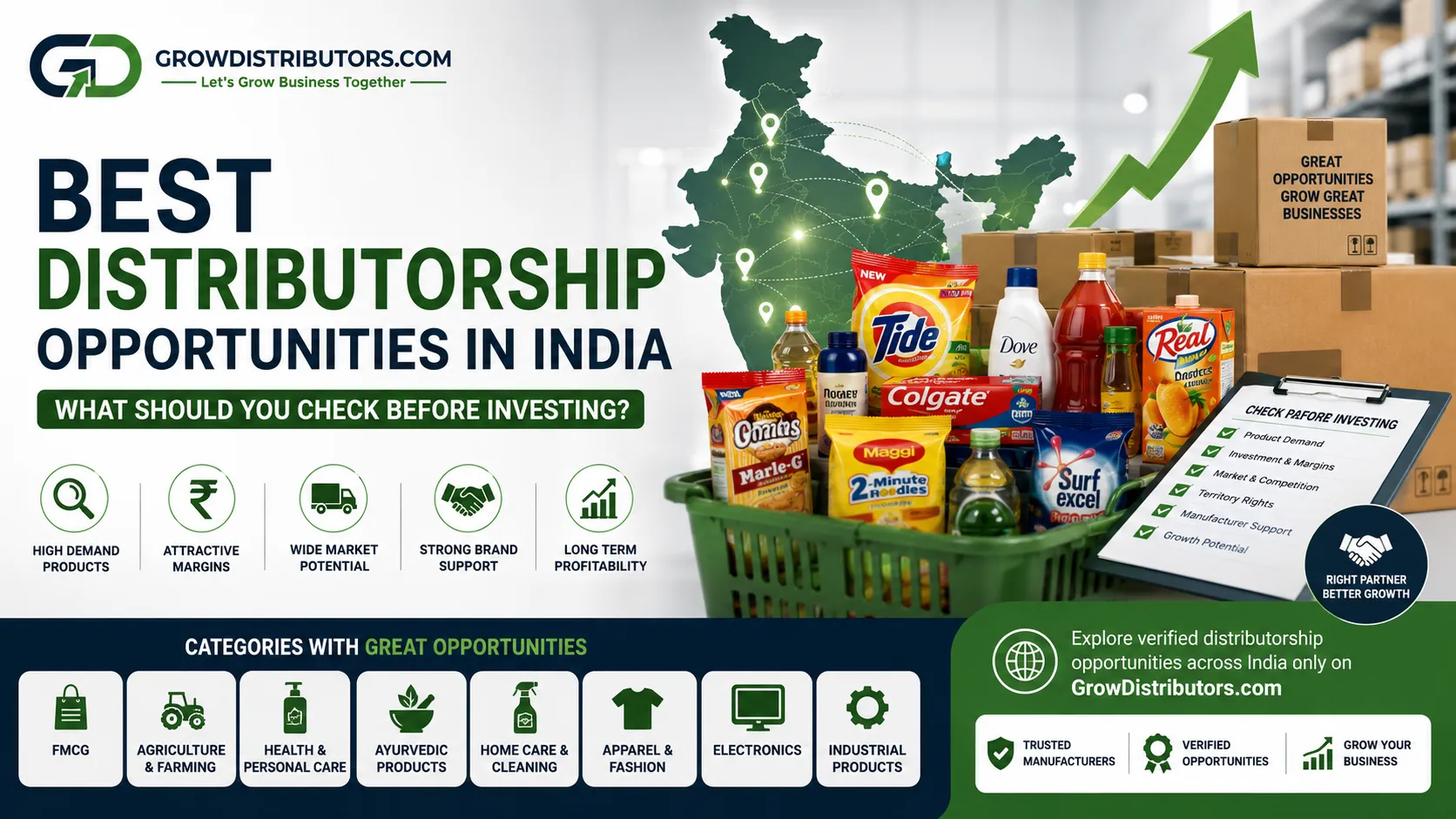
Best Distributorship Opportunities in India: What Should You Check Before Investing?
Best Distributorship Opportunities in India: What Should You Check Before Investing?
Searching for the best distributorship opportunities in India can be exciting.
You may come across brands offering distribution in FMCG, agriculture, personal care, home care, apparel and other categories. Some opportunities may advertise attractive margins, while others may highlight low investment or exclusive territories.
But how do you know which opportunity is actually worth considering?
The answer is simple: don't judge a distributorship opportunity by one number.
Before you invest, evaluate the product, market demand, manufacturer, margins, competition, territory and working capital requirements.
This guide explains what to check before choosing a distribution opportunity.
What Makes a Good Distributorship Opportunity?
A good opportunity generally has several things working together:
Market Demand + Suitable Investment + Competitive Product + Sustainable Margin + Reliable Manufacturer
If even one of these factors is weak, the opportunity may become difficult to operate.
For example, a manufacturer may offer a high distributor margin, but if retailers don't want the product, generating sales can still be challenging.
1. Look at Product Demand
The first question should always be:
Will people actually buy this product?
Research:
- Existing demand
- Customer behaviour
- Retailer interest
- Competitors
- Pricing
- Product quality
- Repeat-purchase potential
For everyday products, recurring demand can be an important factor.
This is one reason many entrepreneurs explore FMCG opportunities.
2. Consider FMCG Distributor Opportunities
If you are specifically searching for an FMCG distributor wanted opportunity, look beyond the brand name.
Evaluate:
Product
What exactly are you distributing?
Demand
Do retailers and customers want it?
Competition
Which brands are already available?
Margin
What is the realistic margin after expenses?
Turnover
How quickly can inventory potentially move?
Shelf Life
How long can the products be stored?
Distribution Network
How many retailers can you realistically reach?
FMCG can provide recurring sales opportunities, but individual products still need to be evaluated carefully.
3. Understand the Investment
One of the biggest mistakes new entrepreneurs make is looking only at the initial investment.
Your actual requirement may include:
- Initial inventory
- Warehouse
- Transportation
- Sales staff
- Working capital
- Marketing
- Technology
- Business operations
For example, if a manufacturer says the initial product investment is ₹2 lakh, your actual business requirement could be higher after considering warehouse, transportation, and working capital.
Always calculate the total operating requirement.
4. Compare Distributor Margins
Suppose one manufacturer offers a 20% margin while another offers 30%.
Does that automatically mean the second opportunity is better?
Not necessarily.
You also need to consider:
- Product turnover
- Operating costs
- Competition
- Discounts
- Retailer margins
- Credit period
- Transportation costs
A product with a lower margin but faster turnover can sometimes generate better overall business results.
5. Check the Manufacturer
Before becoming a distributor, research the manufacturer.
Look at:
- Company background
- Product quality
- Existing market presence
- Manufacturing capacity
- Customer reviews
- Marketing support
- Distribution policies
- Supply consistency
If the manufacturer cannot consistently supply inventory, your retailer relationships can suffer.
6. Understand the Territory
Territory can significantly affect the potential of a distribution business.
Ask whether the opportunity is available for:
- City
- District
- State
- Region
- Multiple states
Also clarify whether the territory is exclusive.
If you are investing in warehouse infrastructure and a sales team, you should know exactly what market you are expected to develop.
7. Evaluate Competition
Competition isn't necessarily bad.
In fact, an established category can indicate existing customer demand.
The real question is:
What makes this product different?
It could be:
- Price
- Quality
- Packaging
- Product features
- Distribution model
- Brand positioning
- Customer service
If ten established brands dominate the market and the new product offers no meaningful difference, building retailer interest may be harder.
8. Check the Sales Potential
Before accepting a distributor needed opportunity, estimate your potential market.
Identify:
- Number of retailers
- Relevant wholesalers
- Potential institutional buyers
- Competitor presence
- Average order size
- Possible sales frequency
You don't need a perfect forecast.
You need a realistic estimate that helps you decide whether the opportunity makes commercial sense.
9. Look for Manufacturer Support
Manufacturer support can make the distributor's job easier.
Ask whether the company provides:
- Marketing materials
- Product training
- Sales support
- Promotional schemes
- Product catalogues
- Digital marketing support
- Retailer promotion
The level of support varies from company to company.
Make sure you understand what is actually included before signing an agreement.
Where Can You Find Distributor Opportunities?
Entrepreneurs can explore opportunities through:
- Manufacturer websites
- Trade exhibitions
- Business networks
- Industry associations
- Referrals
- B2B platforms
- Distribution marketplaces
Platforms such as GrowDistributors can help entrepreneurs discover manufacturers and brands that are looking for distribution partners.
If you're actively searching for distributor opportunities, a focused B2B platform can make it easier to explore opportunities by category and business requirements.
What About New Products?
New product launches can create opportunities for entrepreneurs who are willing to develop a market.
Manufacturers may actively search for distributors required for new products when they want to enter new cities or states.
However, new products also carry additional uncertainty.
Before investing, ask:
- Is the product already selling anywhere?
- What customer problem does it solve?
- What is the expected target market?
- What marketing support is available?
- How much initial inventory is required?
- What happens if the product doesn't sell?
Don't assume that a new product will automatically become successful.
How GrowDistributors Can Help
For entrepreneurs searching for distributorship opportunities, finding relevant manufacturers can be one of the biggest challenges.
GrowDistributors is a B2B platform focused on bringing manufacturers, brands and potential distributors together.
Entrepreneurs can use such a platform to discover potential opportunities across categories such as:
- FMCG
- Agriculture & farming
- Health & personal care
- Ayurvedic products
- Home care & cleaning
- Apparel & fashion
- Electronics
- Industrial products
Manufacturers can also use GrowDistributors when they have a distributor needed requirement and want to make their opportunity visible to potential business partners.
The platform can therefore support both sides of the distribution ecosystem.
Checklist Before You Become a Distributor
Before you decide to became a distributor, use this simple checklist:
- Research the manufacturer
- Understand product demand
- Calculate total investment
- Check distributor margin
- Study competition
- Understand territory
- Review minimum order quantity
- Ask about marketing support
- Understand payment terms
- Read the distribution agreement
- Estimate realistic sales potential
If the opportunity passes this checklist, you can move to a more detailed discussion with the manufacturer.
Frequently Asked Questions
Where can I find distributorship opportunities in India?
You can explore manufacturer websites, trade events, industry networks and B2B platforms such as GrowDistributors to discover potential opportunities.
How do I know if a distributorship opportunity is good?
Evaluate product demand, investment, margins, competition, territory, manufacturer reputation, sales potential and support before making a decision.
Is FMCG distribution a good business opportunity?
FMCG can offer recurring-demand products, but profitability depends on the specific product, market, competition, margins, turnover and operating costs.
What does “distributor needed” mean?
It generally means a manufacturer or brand is looking for a business partner to distribute its products within a particular market or territory.
Can I find opportunities for new products?
Yes. Manufacturers launching new products may actively look for distributors in different cities, districts or states. Such opportunities should be evaluated carefully because new products may have less established market demand.
Final Thoughts
The search for distributorship opportunities should begin with research, not investment.
Don't choose an opportunity simply because the company promises high margins or low investment.
Look at the complete picture:
Product → Demand → Manufacturer → Territory → Investment → Margin → Competition → Sales Potential
If you're an entrepreneur searching for distributor opportunities, platforms such as GrowDistributors can help you discover manufacturers and brands looking for distribution partners.
And if you're a manufacturer with distributors required for new products, reaching the right distribution partners can be an important step toward expanding your market.
The best opportunity is ultimately the one where the product has genuine demand, the economics are realistic and both the manufacturer and distributor have room to grow.