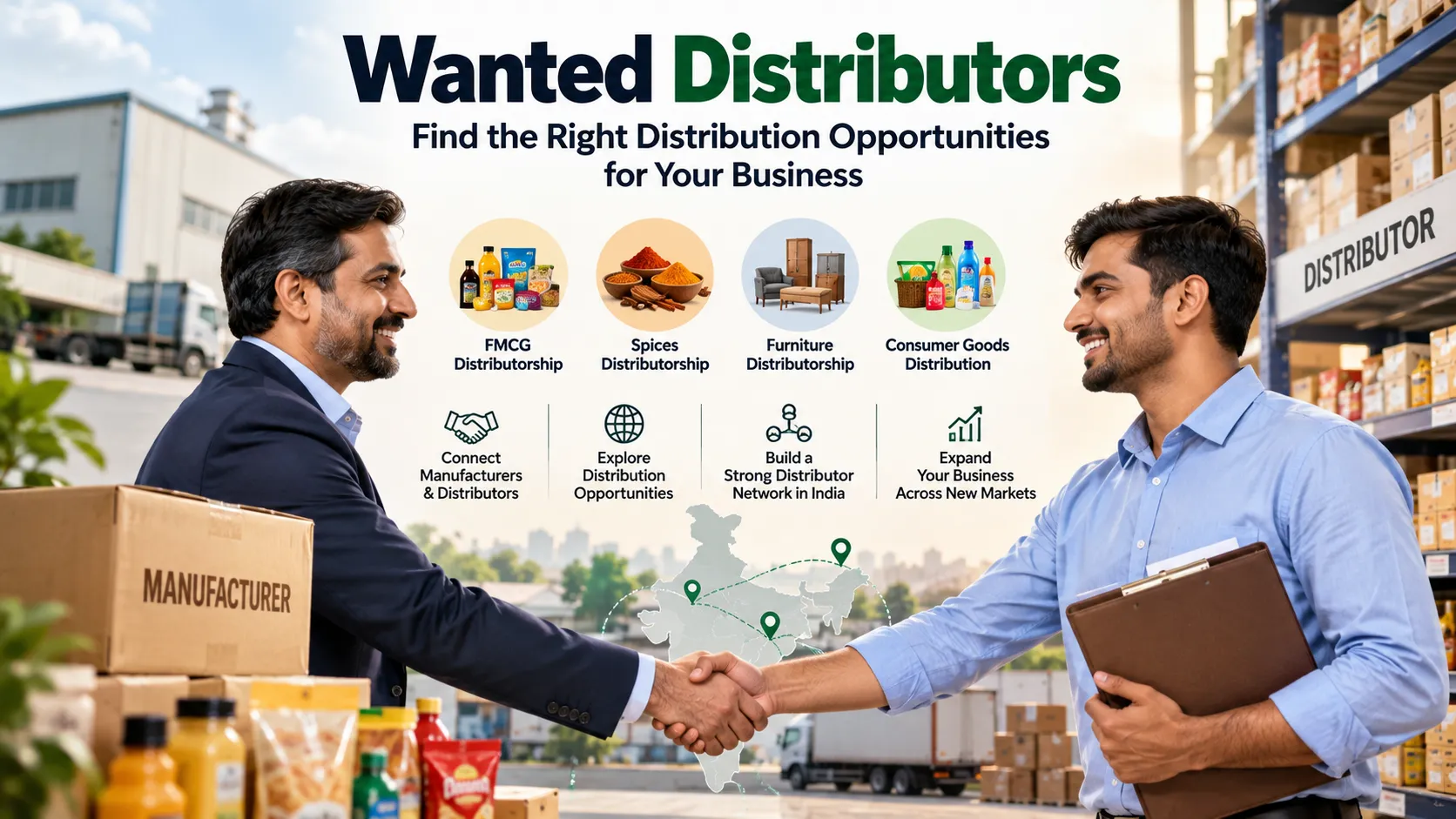
FMCG Distributorship Opportunities in India: Find the Right Business Opportunity
If you're actively searching for FMCG distributorship opportunities, you're probably looking for a practical business opportunity rather than simply learning what distribution means.
You may want to partner with a manufacturer, invest in inventory, and build a retailer network in your city or region.
But with so many products and brands in the market, choosing the right opportunity can be challenging.
A good FMCG distribution opportunity isn't necessarily the one advertising the highest margin. The better opportunity is usually the one where product demand, investment, margins, market potential, and manufacturer support work together.
What Is an FMCG Distributorship?
FMCG stands for Fast-Moving Consumer Goods.
These are products that consumers purchase frequently, such as:
- Packaged foods
- Snacks
- Beverages
- Grocery products
- Personal care products
- Household products
- Cleaning products
An FMCG distributor purchases or receives products from a manufacturer and helps move them into the local market through retailers, wholesalers, and other business channels.
Why Are FMCG Distributors Needed?
A manufacturer can produce thousands of products but may not have direct relationships with every retailer in India.
This is where distributors become valuable.
A distributor can provide:
- Local market access
- Retailer relationships
- Warehousing
- Product delivery
- Sales support
- Inventory management
- Market development
This is why entrepreneurs frequently see requirements such as "FMCG distributor wanted" or "distributor needed.
How to Choose an FMCG Distribution Opportunity
Before investing, evaluate the opportunity carefully.
1. Check Product Demand
Ask yourself:
Would retailers actually want to stock this product?
Research:
- Local demand
- Competitors
- Pricing
- Customer preferences
- Product quality
- Repeat-purchase potential
A product with genuine demand is generally easier to introduce than one that requires you to create the entire market from scratch.
2. Calculate the Total Investment
Don't look only at the manufacturer's initial inventory requirement.
Your overall business costs may include:
| Requirement | Purpose |
|---|---|
| Initial Inventory | Product stock |
| Warehouse | Storage |
| Transportation | Retailer deliveries |
| Sales Staff | Market development |
| Working Capital | Daily operations |
| Marketing | Local promotion |
Always keep enough working capital for ongoing expenses.
3. Compare Distributor Margins
Suppose a product has a selling price of ₹100 and your purchase price is ₹80.
Your gross margin is ₹20.
But your actual business profit will depend on expenses such as:
- Transportation
- Warehouse
- Salaries
- Discounts
- Credit costs
- Damaged inventory
- Sales expenses
So don't choose an opportunity simply because the advertised margin looks attractive.
4. Check the Brand and Manufacturer
Before becoming a distributor, research the company.
Look for:
- Manufacturing capability
- Product quality
- Market presence
- Customer feedback
- Supply consistency
- Marketing strategy
- Distributor support
A distributor depends on the manufacturer for regular product supply, so reliability matters.
5. Understand Your Territory
A distribution opportunity could cover:
- A city
- District
- Multiple districts
- State
- Region
Before investing, ask exactly which territory is available.
Also clarify whether the manufacturer can appoint another distributor in the same territory.
6. Estimate Retailer Potential
Your business will ultimately depend on selling products into the market.
Identify potential:
- Grocery stores
- Supermarkets
- Convenience stores
- Specialty retailers
- Wholesalers
- Institutional buyers
Then estimate how many outlets you can realistically reach.
A product may have excellent national potential but still be difficult to sell in your particular local market.
Which Other Categories Offer Distribution Opportunities?
FMCG isn't the only category.
Entrepreneurs exploring distributorship opportunities can also look at:
Agriculture & Farming
Agricultural tools, equipment and farming-related products.
Health & Personal Care
Skincare, hygiene, beauty and personal-care products.
Ayurvedic Products
Herbal and Ayurvedic products.
Home Care & Cleaning
Detergents, cleaners and household products.
Apparel & Fashion
Clothing and fashion-related products.
Electronics
Consumer electronics and electrical products.
Industrial Products
Machinery, tools and industrial equipment.
The right category depends on your experience, capital, market access and local demand.
Where Can You Find Distributor Opportunities?
If you're actively looking for distributor opportunities, don't limit your search to one source.
You can explore:
- Manufacturer websites
- Trade exhibitions
- Industry associations
- Business referrals
- B2B marketplaces
- Distribution platforms
GrowDistributors is designed to connect manufacturers, brands and potential distributors.
Entrepreneurs can explore distribution-related business opportunities, while manufacturers can showcase requirements when they have distributors required for new products.
This can make the discovery process more focused for both sides.
What Should You Ask an FMCG Manufacturer?
If you find an FMCG distributor wanted opportunity that interests you, ask these questions before investing:
- What is the initial investment?
- What is the minimum order quantity?
- What margin is offered?
- Are there additional schemes?
- What territory is available?
- Is the territory exclusive?
- What sales targets apply?
- What marketing support is provided?
- What are the payment terms?
- How are damaged or expired products handled?
The answers can help you compare multiple opportunities objectively.
Warning Signs to Watch For
Be careful with opportunities that:
- Guarantee unrealistic profits
- Provide little information about the manufacturer
- Avoid written agreements
- Demand unexplained upfront payments
- Cannot explain the product's market
- Promise guaranteed sales
- Don't clearly define territory or commercial terms
Always conduct your own due diligence before making a business investment.
Frequently Asked Questions
How can I find FMCG distributorship opportunities in India?
You can search manufacturer websites, trade exhibitions, business networks and specialized B2B platforms such as GrowDistributors.
What does “FMCG distributor wanted” mean?
It usually means an FMCG manufacturer or brand is looking for a business partner to distribute its products in a specific market or territory.
How much investment is needed to become an FMCG distributor?
There is no fixed amount. Investment depends on inventory, territory, warehouse requirements, minimum order quantity and working capital.
Is FMCG distribution profitable?
FMCG distribution can be profitable, but results depend on product demand, margins, sales volume, competition, operating expenses and manufacturer support.
Can a beginner become an FMCG distributor?
Yes, depending on the manufacturer's requirements. Investment capacity, market knowledge, retailer connections and operational capability can all be important factors.
Final Thoughts
If you're looking for FMCG distributorship opportunities, don't make your decision based on margin alone.
Evaluate the complete opportunity:
Product Demand → Investment → Margin → Territory → Competition → Retailer Potential → Manufacturer Support
For entrepreneurs, the goal is to find a product that can realistically be sold in their market.
For manufacturers, the goal is to find distributors who can actually develop that market.
Whether you're searching for an FMCG distributor wanted opportunity, a distributor needed requirement, or broader distributor opportunities, platforms such as GrowDistributors can help connect the two sides.
The right distribution partnership can turn a simple product into a scalable business opportunity for both the manufacturer and distributor.