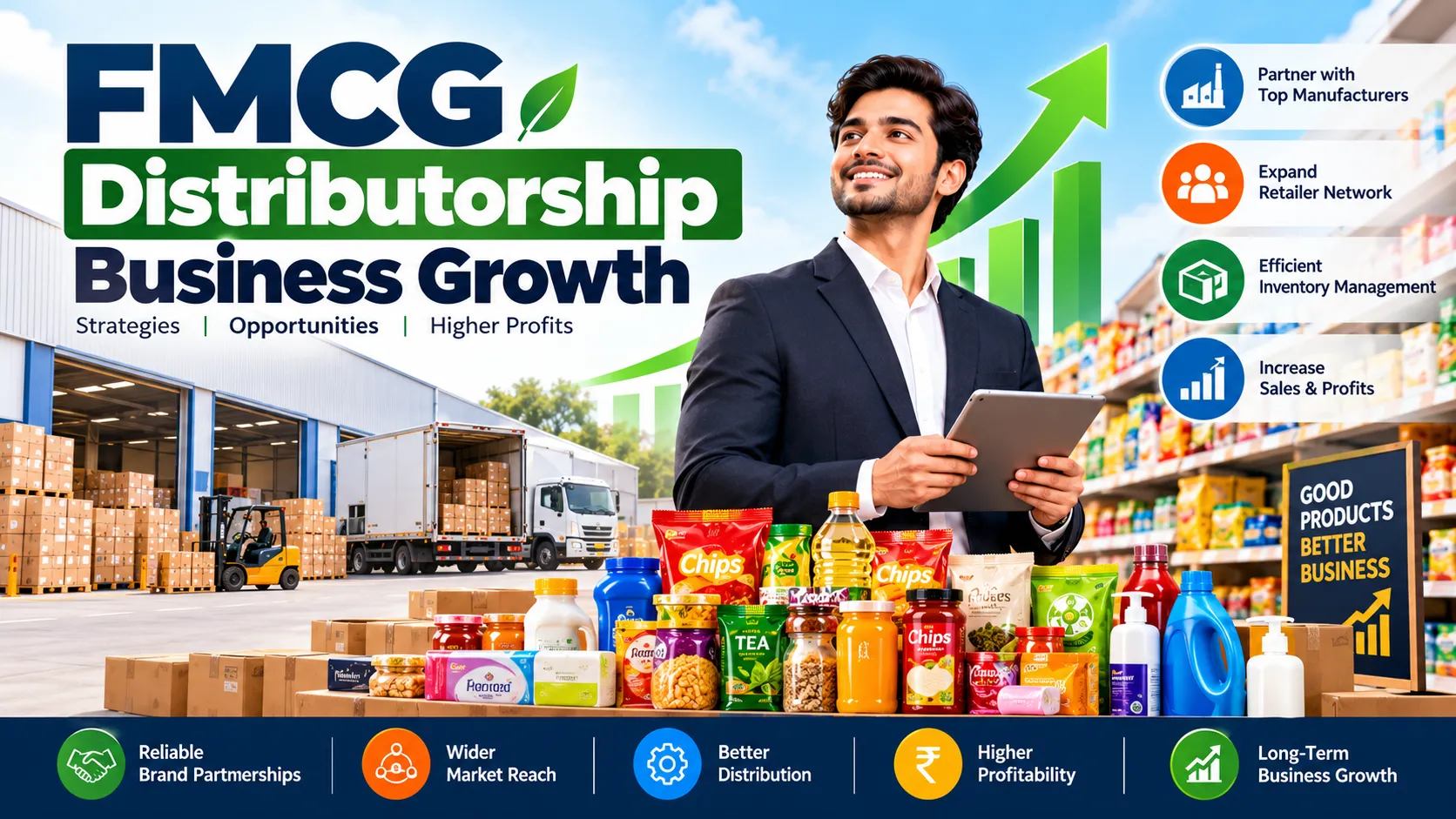
FMCG Distributorship Business Growth: Strategies to Build a Profitable Distribution Business
The Fast-Moving Consumer Goods (FMCG) industry is one of the most active sectors in the Indian economy. Products such as packaged foods, beverages, personal care items, household essentials, and daily-use products are always in demand. This creates significant opportunities for entrepreneurs who want to establish or expand an FMCG distributorship business.
However, FMCG distributorship business growth requires more than simply supplying products to retailers. Distributors must build strong manufacturer relationships, manage inventory efficiently, expand their retailer network, and adopt modern distribution strategies to remain competitive.
Whether you are a new entrepreneur exploring FMCG distribution opportunities or an established distributor looking to increase sales, understanding the right growth strategies can help you build a sustainable business.
What Is an FMCG Distributorship Business?
An FMCG distributorship business involves purchasing products from manufacturers or authorized suppliers and distributing them to retailers, wholesalers, supermarkets, and other businesses.
FMCG distributors act as a link between manufacturers and the retail market. They help brands reach more customers by ensuring products are available at the right locations and at the right time.
Common FMCG product categories include:
- Packaged food and snacks
- Spices and food ingredients
- Beverages and bottled water
- Personal care and hygiene products
- Household cleaning products
- Packaged grocery items
- Baby care and everyday essentials
As consumer demand continues to evolve, businesses involved in FMCG wholesale distribution can explore opportunities by expanding product categories, entering new territories, and partnering with emerging brands.
Why FMCG Distributorship Business Growth Matters
Growth is essential for distributors who want to increase revenue, improve profitability, and establish a stronger position in the market.
A growing distribution business can benefit from a wider customer base, higher order volumes, stronger manufacturer relationships, and improved operational efficiency.
The major factors driving FMCG distribution growth include:
1. Consistent consumer demand: Daily-use products are purchased regularly, creating repeat-order opportunities.
2. Expanding retail networks: Kirana stores, supermarkets, convenience stores, and local retailers require reliable product suppliers.
3. New brand opportunities: Emerging FMCG companies often need distribution partners to enter new markets.
4. Digital transformation: Online platforms and digital business tools make it easier to discover brands, connect with manufacturers, and identify new distribution opportunities.
5. Regional market expansion: Distributors can grow by entering underserved locations and adding products that meet local consumer preferences.
7 Effective Strategies for FMCG Distributorship Business Growth
1. Partner With the Right FMCG Manufacturers
Choosing the right manufacturer is one of the most important decisions in the distribution business. A distributor's growth depends on product demand, pricing, supply reliability, brand reputation, and the commercial terms offered by the supplier.
Before entering an FMCG distributorship agreement, Evaluate:
- Product quality and market demand
- Distributor margins and payment terms
- Minimum order quantities
- Territory and exclusivity conditions
- Marketing and promotional support
- Product shelf life and return policies
- Delivery schedules and supply consistency
Working with multiple complementary brands can also help distributors serve more retailers and reduce dependence on a single product line.
2. Expand Your Retailer and Wholesaler Network
A strong retailer network is the foundation of a successful FMCG distribution business. Even if you have quality products, sales growth may remain limited without enough active buyers.
To expand your network, identify potential customers such as:
- Kirana stores and neighborhood shops
- Supermarkets and grocery stores
- Restaurants, hotels, and cafés
- Institutional buyers
- Regional wholesalers
- Retail chains and convenience stores
Create a systematic process for approaching retailers, sharing product catalogues, communicating price lists, and following up on orders.
Maintaining consistent contact with existing customers can also encourage repeat purchases and improve customer retention.
3. Use Digital Platforms to Find Distribution Opportunities
Traditional networking remains valuable, but digital platforms provide another way to discover manufacturers, brands, and business partners.
B2B marketplaces help distributors explore products, compare business opportunities, and connect with companies looking to expand their distribution networks.
GrowDistributors.com helps bring manufacturers, brands, and distributors together through a business-focused platform. Distributors can explore potential partnerships and discover product categories that align with their market and customer base.
Digital discovery can be particularly useful for entrepreneurs searching for terms such as:
- FMCG distributorship opportunities
- FMCG companies looking for distributors
- Distributorship business in India
- New FMCG products for distribution
- Wholesale distribution business opportunities
- FMCG distributor required
- Authorized distributorship opportunities
- Manufacturers looking for distributors
Using online platforms alongside local market research can help distributors build a broader pipeline of potential business partnerships.
4. Improve Inventory and Supply Chain Management
Inventory management directly affects profitability. Overstocking can tie up working capital and increase the risk of expiry, while understocking can result in missed orders and dissatisfied retailers.
To improve inventory management:
- Track fast-moving and slow-moving products.
- Monitor expiry dates and batch numbers.
- Maintain appropriate safety stock for high-demand items.
- Forecast demand using historical sales data.
- Coordinate replenishment with manufacturers.
- Use inventory management software or structured spreadsheets.
- Review delivery costs and warehouse utilization.
For FMCG products with limited shelf life, the first-expiry-first-out (FEFO) approach helps ensure products closest to expiry are dispatched first.
Efficient inventory control can reduce avoidable losses and support more reliable order fulfilment.
5. Strengthen Your Sales and Distribution Strategy
A successful FMCG sales and distribution strategy should focus on increasing both customer acquisition and the value of existing accounts.
Distributors can improve sales performance by:
- Setting realistic monthly sales targets.
- Assigning sales representatives to specific territories.
- Planning regular retailer visits.
- Offering product demonstrations where appropriate.
- Introducing complementary products to existing buyers.
- Monitoring order frequency and average order value.
- Reviewing retailer feedback and competitor pricing.
For example, a distributor supplying packaged spices to local grocery stores may introduce complementary grocery products to existing customers. This can increase the range of products purchased without requiring an entirely new customer network.
Growth should be measured through profitable sales, not just higher order volumes.
6. Explore New Markets and Product Categories
Once the existing distribution network becomes stable, consider expanding into new geographical areas or complementary FMCG categories.
Market expansion may involve entering nearby towns, developing new retail territories, or supplying additional types of businesses.
Before expanding, assess:
- Local customer demand
- Competitor presence
- Transportation and delivery expenses
- Retailer purchasing capacity
- Supplier availability
- Expected margins and working capital requirements
Start with a manageable expansion plan and evaluate the results before making a larger investment.
Adding a new category or territory without understanding demand can increase operating costs instead of improving profitability.
7. Build Long-Term Manufacturer Relationships
Strong manufacturer relationships help distributors access reliable supplies, new products, promotional support, and better coordination.
Maintain transparent communication about sales performance, customer feedback, stock availability, and market challenges.
Distributors should also understand the manufacturer's expectations regarding sales targets, territory coverage, payment schedules, and brand presentation.
A reliable distribution partner who consistently serves the market can become valuable to manufacturers seeking long-term regional growth.
How Technology Can Improve FMCG Distribution Business Growth
Technology can make distribution operations more organized, measurable, and scalable.
Useful digital tools include:
- Inventory software: Track stock levels, batches, and expiry dates.
- Accounting software: Monitor payments, outstanding invoices, and expenses.
- CRM systems: Manage retailer relationships and sales follow-ups.
- Route planning tools: Optimize delivery routes and reduce unnecessary travel.
- B2B marketplaces: Discover manufacturers and potential distribution partners.
- Digital catalogues: Share product information and pricing with prospective buyers.
Even small distributors can begin with basic digital tools before investing in advanced systems. The objective is to reduce manual errors, improve visibility, and make better business decisions.
Common Challenges in FMCG Distributorship
Despite its potential, FMCG distribution comes with several challenges.
Low profit margins: High competition and operating costs can reduce net profitability. Focus on cost control, efficient delivery, and suitable product selection.
Delayed retailer payments: Credit sales can create cash-flow pressure. Establish clear credit limits and follow-up procedures.
Inventory losses: Expired, damaged, or unsold stock can affect returns. Monitor demand and maintain disciplined stock rotation.
Intense competition: Other distributors may offer similar products. Differentiate through dependable delivery, service quality, and product availability.
Limited access to brands: New distributors may struggle to identify manufacturers seeking partners. B2B networking and online distribution platforms can help broaden their search.
Addressing these challenges early makes it easier to build a stable and sustainable distribution business.
How to Measure FMCG Distribution Business Growth
Distributors should track performance regularly instead of relying only on total sales figures.
Important business metrics include:
| Metric | Why It Matters |
|---|---|
| Monthly sales revenue | Measures overall sales performance |
| Gross profit margin | Shows the difference between sales and product costs |
| Net profit margin | Measures profitability after operating expenses |
| Active retailers | Indicates the strength of the customer network |
| Repeat-order rate | Helps assess customer retention |
| Inventory turnover | Measures how efficiently stock is sold |
| Outstanding payments | Highlights potential cash-flow problems |
| On-time delivery rate | Measures service reliability |
Review these metrics monthly and identify which products, customers, and territories contribute most effectively to business performance.
How GrowDistributors.com Can Support Distribution Opportunities
Finding suitable manufacturers and reliable distribution partners is a key step in growing an FMCG distribution business.
GrowDistributors.com is a B2B platform designed to connect manufacturers, brands, and distributors. It offers businesses another channel to explore product opportunities and build potential commercial relationships.
Distributors can use platforms like GrowDistributors.com to discover brands, explore relevant product categories, and identify potential partnerships for market expansion.
Manufacturers can also use B2B distribution platforms to improve business visibility and connect with potential channel partners.
For the best results, combine online discovery with due diligence, market research, product evaluation, and direct discussions with manufacturers before entering into any distribution agreement.
Frequently Asked Questions (FAQs)
1. How can I grow my FMCG distributorship business?
You can grow your FMCG distributorship by expanding your retailer network, partnering with suitable manufacturers, managing inventory efficiently, improving sales operations, and exploring new markets. Digital B2B platforms can also help you discover additional distribution opportunities.
2. Is FMCG distributorship a profitable business in India?
FMCG distribution can be profitable when product demand, purchase prices, operating costs, credit management, and sales volumes are managed effectively. Actual profitability depends on the product category, location, manufacturer terms, and business execution.
3. How do I find FMCG companies looking for distributors?
You can search B2B marketplaces, visit manufacturer websites, attend trade exhibitions, contact regional sales teams, and network with industry professionals. Platforms such as GrowDistributors.com can provide an additional channel for discovering potential manufacturer partnerships.
4. What is the investment required for an FMCG distributorship?
Investment varies depending on the brand, product category, territory, minimum orde quantity, warehouse requirements, delivery arrangements, and working capital. Review the complete cost structure before committing funds.
5. Which FMCG products are suitable for distribution?
Packaged foods, spices, personal care products, household cleaning items, beverages, and grocery essentials are common categories. The right choice depends on local demand, competition, shelf life, product margins, and supplier reliability.
6. Can a small distributor compete with established FMCG companies?
Yes. Small distributors can compete within selected territories by providing dependable service, maintaining stock availability, building strong retailer relationships, and focusing on underserved markets or suitable emerging brands.
7. How can a manufacturer find distributors for FMCG products?
Manufacturers can build relationships through trade fairs, industry networks, digital marketing, and B2B distribution platforms. A clear product catalogue, competitive commercial terms, and defined territory requirements can help attract relevant distribution partners.
Conclusion
FMCG distributorship business growth depends on the right combination of manufacturer partnerships, retailer relationships, inventory management, market expansion, and digital tools. Distributors who consistently improve their operations and understand local demand are better positioned to build sustainable businesses.
Whether you are starting a new FMCG distribution business or expanding an established operation, focus on profitable growth, reliable service, and long-term partnerships.
Explore GrowDistributors.com to discover potential business connections between manufacturers, brands, and distributors and take the next step toward expanding your distribution network.