How Does the Distribution Business Work in India? Complete Guide
How Does the Distribution Business Work in India? A Complete Guide
If you have ever purchased a product from a local shop and wondered how it actually reached there, the answer often involves a distribution network.
A manufacturer produces the product, but getting that product into hundreds or thousands of shops across different cities is a completely different challenge. This is where distributors play an important role.
The distribution business connects manufacturers with retailers, dealers, wholesalers and other businesses. For entrepreneurs, it can also become a business opportunity because distributors can build relationships with brands and develop markets within specific territories.
In this guide, we will explain how the distribution business works in India, how distributors make money, what manufacturers look for in a distribution partner and how someone can explore distribution opportunities.
What Is a Distribution Business?
A distribution business involves purchasing, handling or supplying products from manufacturers or brands and making them available to businesses within a particular market.
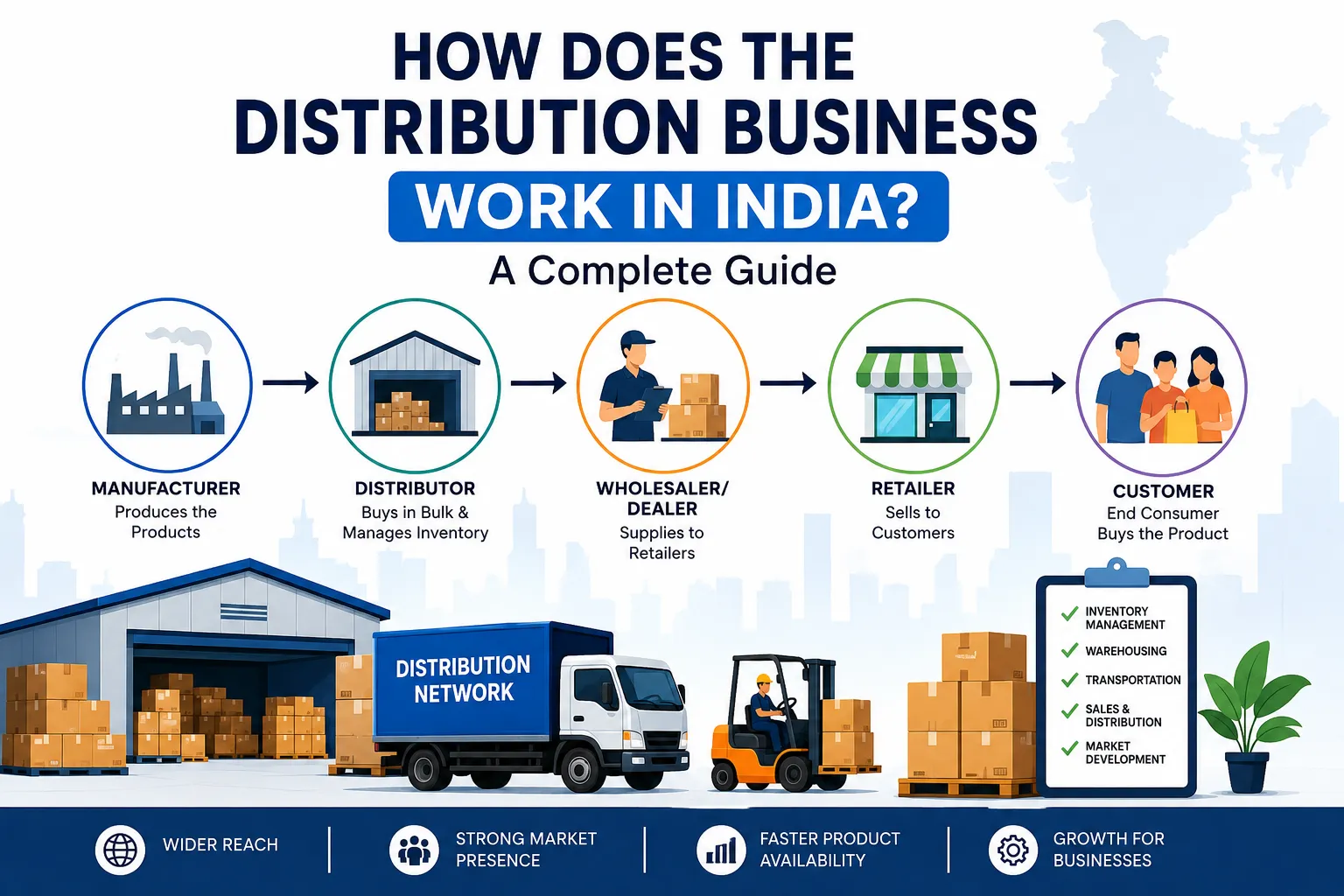
A simplified supply chain looks like this:
Manufacturer → Distributor → Wholesaler/Dealer → Retailer → Customer
However, every industry doesn't follow exactly the same structure.
For example, some manufacturers may sell directly to distributors, while others may appoint dealers or supply wholesalers directly.
The distributor's main responsibility is generally to make products available in the right market while helping the manufacturer expand its reach.
How Does Distribution Work?
The process usually starts with a manufacturer looking for a suitable business partner.
The manufacturer may have products ready for expansion but may not have direct relationships with retailers in every city.
A distributor can fill this gap.
A typical process looks like this:
1. Manufacturer produces the product
The company manufactures or sources the product and prepares it for market distribution.
2. Distributor is appointed
The manufacturer selects a distributor based on territory, investment, infrastructure and market experience.
3. Distributor purchases inventory
The distributor purchases products according to the agreed commercial terms.
4. Products enter the local market
The distributor supplies products to retailers, dealers, wholesalers or institutional buyers.
5. Retailers sell the products
Finally, the products reach consumers through retail or other sales channels.
This process allows manufacturers to expand without having to manage every local retailer themselves.
Why Are Distributors Important for Manufacturers?
Imagine a manufacturer has 10,000 potential retailers across several states.
Contacting and servicing every retailer directly could require a large sales team, warehouses and logistics infrastructure.
A distributor can help manage the local market.
Some major advantages include:
- Wider geographical reach
- Local retailer relationships
- Regional inventory management
- Faster product availability
- Reduced operational complexity
- Local market knowledge
- Better sales coverage
- Repeat order management
This is why manufacturers often look for distributors required for new products when launching a product in a new market.
How Do Distributors Make Money?
Most distributors earn through the margin between their purchase price and selling price.
For example:
Purchase price: ₹80
Selling price: ₹100
Gross margin: ₹20
But the ₹20 difference isn't necessarily the distributor's final profit.
The distributor may also have expenses such as:
- Warehouse rent
- Staff salaries
- Transportation
- Fuel
- Electricity
- Sales expenses
- Damaged inventory
- Credit costs
Therefore, a distributor should evaluate both margin and sales volume before accepting an opportunity.
What Types of Products Use Distribution Networks?
Distribution is used across many industries.
FMCG
Fast-moving consumer goods are one of the most common categories.
Examples include:
- Snacks
- Packaged foods
- Beverages
- Personal-care products
- Household products
- Cleaning products
Manufacturers entering new markets may actively advertise an FMCG distributor wanted requirement.
Agriculture & Farming
Agricultural products such as equipment, tools, seeds and irrigation-related products can use distributors and dealers to reach local markets.
Health & Personal Care
Skincare, hygiene, cosmetics and wellness products may require distributors with relationships with pharmacies, salons, retailers and specialty stores.
Ayurvedic Products
Herbal and Ayurvedic brands can work with distribution partners who understand health and wellness markets.
Apparel & Fashion
Clothing manufacturers and brands may use distributors, wholesalers and dealers depending on their business model.
Home Care & Cleaning
Cleaning products and household supplies can be distributed through wholesalers, retailers and regional distributors.
Electronics & Industrial Products
Electronics, machinery, electrical products and industrial supplies can also use distribution networks.
What Makes a Good Distributor?
A manufacturer shouldn't choose a distributor simply because they have enough money to invest.
The right partner should ideally have:
- Relevant market experience
- Retailer or dealer connections
- Adequate working capital
- Warehouse facilities
- Transportation capabilities
- Sales staff
- Knowledge of the product category
- Good market reputation
For example, a distributor experienced in FMCG may not necessarily be the right choice for industrial machinery.
Market fit matters.
What Should Entrepreneurs Know Before Becoming a Distributor?
People searching for became a distributor opportunities should understand that distribution is a business, not simply an investment.
Before starting, consider:
Investment
Determine how much working capital you will need for inventory, warehouse operations, staff and transportation.
Territory
Understand whether you will operate in a city, district, state or larger territory.
Product Demand
Research whether retailers and customers actually need the product.
Competition
Check how many competing brands are already operating in the market.
Margin
Don't look only at the percentage margin. Calculate your expected net profit after expenses.
Manufacturer Support
Marketing material, training, promotional schemes and sales support can make a significant difference.
How Can You Find Distribution Opportunities?
If you're searching for distributorship opportunities, there are several ways to find them.
You can explore:
- Trade exhibitions
- Industry associations
- Manufacturer websites
- Business networks
- Referrals
- B2B platforms
- Distribution marketplaces
Online platforms can make the process easier because manufacturers can publish their requirements and potential distributors can discover opportunities based on category and location.
GrowDistributors is one such B2B platform designed to connect manufacturers and brands with potential distributors, dealers and super-stockists.
For manufacturers with a distributor needed requirement, platforms like this can provide another channel to discover potential business partners.
Common Distribution Business Mistakes
New distributors should avoid several common mistakes.
Buying Too Much Inventory
Don't invest heavily before understanding demand.
Ignoring Operating Costs
Warehouse, transportation and staff expenses can significantly affect profitability.
Choosing Products Only Because of High Margins
A high-margin product isn't useful if it doesn't sell.
Not Understanding the Territory
Market demand can vary significantly between cities and regions.
Taking on Too Many Brands
Managing multiple brands can become difficult if your sales and logistics infrastructure is limited.
Frequently Asked Questions
Is distribution a good business in India?
Distribution can be a viable business model when there is strong product demand, suitable margins, good market coverage and effective inventory management.
How much investment is required to become a distributor?
There is no fixed amount. Investment depends on the product category, minimum order quantity, territory, warehouse requirements and manufacturer terms.
How do I find distributors for a new product?
Manufacturers can use industry contacts, trade events, direct outreach and B2B platforms such as GrowDistributors to discover potential partners.
What is the difference between a distributor and wholesaler?
A distributor often has a structured relationship with a manufacturer and may manage a territory, while a wholesaler generally focuses on buying products in bulk and reselling them to businesses.
Which products are best for distribution?
FMCG, food and beverages, agriculture, personal care, home care, electronics, apparel and industrial products can all use distribution networks.
Final Thoughts
The distribution business works because it solves a simple but important problem: how to move products from manufacturers into local markets efficiently.
For manufacturers, distributors can provide market reach, retailer relationships and regional infrastructure. For entrepreneurs, distribution can provide an opportunity to build a business around established or growing product brands.
If you're researching distributor opportunities, focus on product demand, territory, margins, competition and the quality of the manufacturer before making a decision.
And if you're a manufacturer searching for potential partners, GrowDistributors can help you showcase your distribution requirements and connect with businesses exploring distribution opportunities.